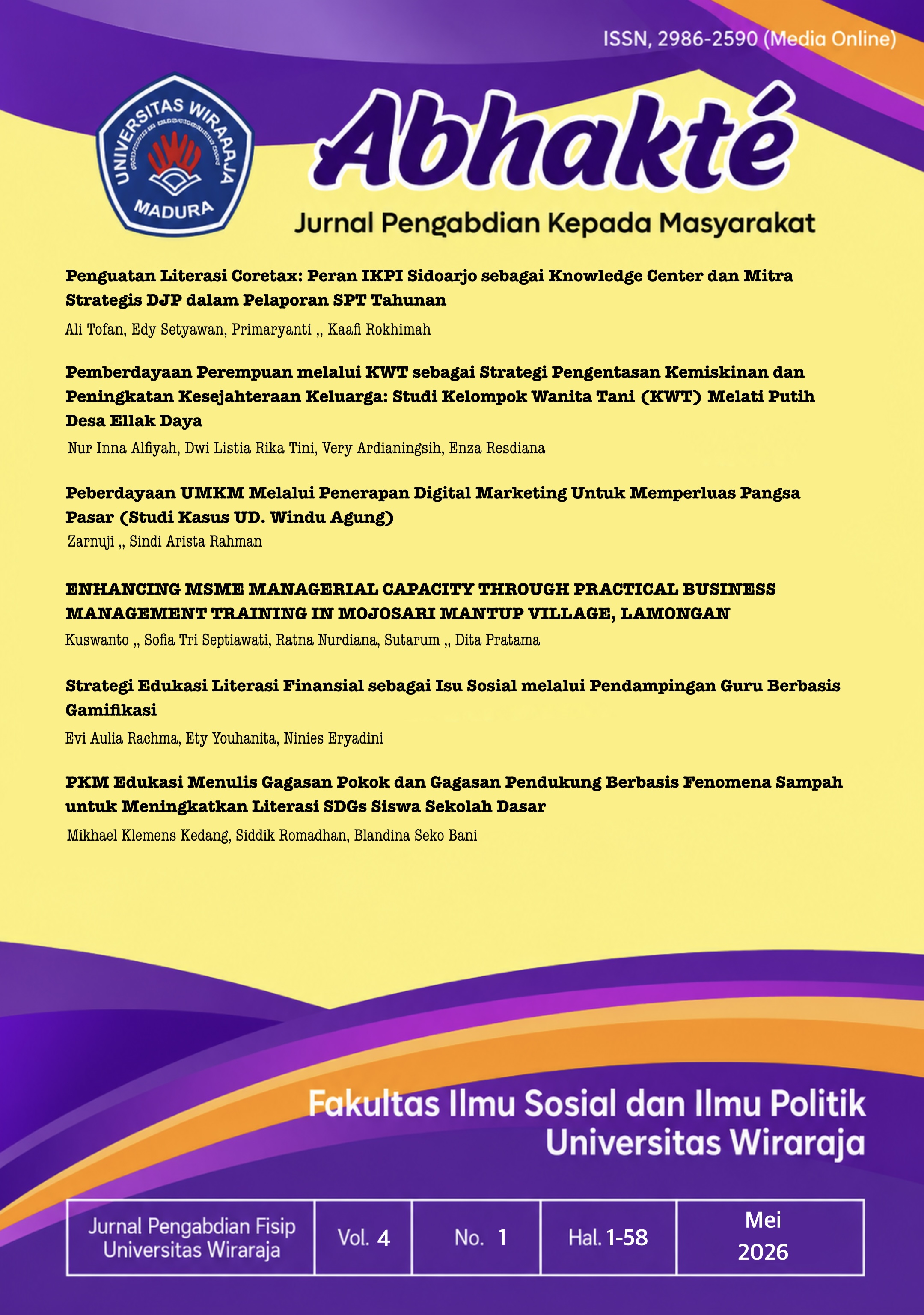
PKM Edukasi Menulis Gagasan Pokok dan Gagasan Pendukung Berbasis Fenomena Sampah untuk Meningkatkan Literasi SDGs Siswa Sekolah Dasar
Pemanfaatan Fenomena Sampah untuk Meningkatkan Literasi SDGs pada Siswa Sekolah Dasar
Abstract
One of the global issues in achieving the Sustainable Development Goals (SDGs) in education and environmental sustainability is waste management. In the educational context, students’ ability to understand and communicate environmental issues through literacy activities remains relatively low. This Community Service Program (PkM) aimed to improve students’ SDGs literacy through education on writing main ideas and supporting ideas based on waste-related phenomena.The program employed an experiential learning approach consisting of four stages: (1) introducing students to environmental issues related to the types, impacts, and management of waste (concrete experience); (2) identifying organic and inorganic waste (reflective observation); (3) discovering creative products made from waste materials (abstract conceptualization); and (4) practicing paragraph writing containing main ideas and supporting ideas based on the previous activities (active experimentation). The target participants were fourth-grade students of SD Sikumana 2 in Kupang City, East Nusa Tenggara (NTT). The results of the community service activity showed that students were able to understand the concepts of main ideas and supporting ideas more effectively through contextual and experience-based learning. Most students succeeded in composing coherent, well-structured, and environmentally relevant paragraphs. In addition, students demonstrated increased ecological awareness through maintaining school cleanliness and identifying simple forms of waste management.Therefore, this activity was effective in integrating language literacy and environmental literacy based on the SDGs in elementary school learning. The implications of this activity highlight the importance of strengthening contextual and environment-based learning to develop students’ literacy skills and environmental awareness from an early age.
References
Kolb, David. (1984). Experiential learning: Experience as the source of learning and development. Prentice Hall.
Kharisna, M., Hidayat, T., & Putri, S. (2025). Implementasi education for sustainable development dalam pembelajaran sekolah dasar. Jurnal Pendidikan Berkelanjutan, 4(1), 33–45.
OECD. (2019). Future of education and skills 2030. OECD Publishing.
Pratama, R., Nugroho, A., & Wibowo, H. (2026). Literasi lingkungan siswa sekolah dasar dalam menghadapi isu keberlanjutan. Jurnal Pendidikan Lingkungan Indonesia, 11(1), 1–12.
Rahmawati, I., Siregar, D., & Lestari, N. (2025). Pembelajaran menulis berbasis isu lingkungan untuk meningkatkan berpikir kritis siswa sekolah dasar. Jurnal Literasi Pendidikan, 6(1), 55–67.
Ruswendi, A., Fadilah, R., & Kurniawan, M. (2024). Pendidikan berkelanjutan dan penguatan karakter peduli lingkungan di sekolah dasar. Jurnal Pendidikan Karakter, 14(2), 210–223.
Sari, N., Wijayanti, E., & Putra, Y. (2025). Integrasi literasi dan SDGs dalam pembelajaran sekolah dasar. Jurnal Inovasi Pendidikan Dasar, 9(1), 77–89.
UNEP. (2025). Global waste management outlook 2025. UNEP.
UNESCO. (2017). Education for sustainable development goals: Learning objectives. UNESCO Publishing.
UNESCO. (2025). Global education monitoring report 2025: Education and sustainability. UNESCO Publishing.
Widiyantti, P., Hapsari, D., & Arifin, Z. (2024). Pembelajaran kontekstual untuk meningkatkan motivasi dan keterampilan menulis siswa sekolah dasar. Jurnal Bahasa dan Pembelajaran, 12(3), 145–156.
World Bank. (2018). What a waste 2.0: A global snapshot of solid waste management to 2050. World Bank.
Yuliasih, T., Mahendra, F., & Kusuma, R. (2025). Analisis literasi lingkungan siswa sekolah dasar pada pembelajaran berbasis proyek. Jurnal Pendidikan Sains Indonesia, 13(2), 98–109.